Showing posts with label CloudSecurity. Show all posts

Monday, September 8, 2025

Cloud Security Theater: Why Azure "Best Practices" Don’t Actually Make You Secure (With guest blogger, Joshua Copeland)

Alone a checklist is worthless.

Joshua Copeland and Jean-Paul Lizotte

Image generated by AI.


Everyone loves a checklist. Microsoft publishes them. Consultants bill by them. CISOs cling to them. But here's the quiet part out loud: Azure best practices are more about passing audits than stopping attackers.

They look good in a board report. They check the compliance box. But they don't reflect how adversaries actually move, exploit, and pivot in cloud environments. What we're left with is "security theater"; the illusion of safety without the substance of resilience. It's all for show.


The Problem With "Best Practices"

"Best practices" sound comforting. They're the shiny guardrails vendors hand you, the box every auditor wants checked, the phrase every executive clings to when they don't really understand the risk. But here's the problem: most Azure best practices aren't actually designed to stop attackers, at least not today's attackers, they're designed to create the appearance of security. They standardize the minimum, not the maximum. They solve for compliance optics, not for adversarial pressure. And when organizations treat them as gospel, they end up building fragile systems that look secure on paper but crumble the moment someone decides to really test them.

They're marketing, not security.

Most Azure "best practices" are written to showcase how polished the platform looks, not how it actually holds up under attack. They're generalized, vendor-friendly configurations meant to look great in a PowerPoint deck or satisfy a compliance audit. The problem? Real adversaries don't care about clean dashboards or neatly aligned policies. They look for the exceptions, the legacy accounts no one touched, the misconfigured service principal quietly holding global admin. Best practices create the illusion of a fortress, but too often it's a cardboard cutout…perfect for a sales demo, useless in a breach.

They lag reality.

By the time guidance is published, attackers have already shifted tactics. MFA bypass kits, token theft, and misconfigured identity federations aren't addressed in the glossy PDFs. Standards be the vendor, industry, or government take months to years to formalize. When the threats are changing daily, they will never be accurate to the current threat landscape.

They measure compliance, not resilience.

Passing an Azure security benchmark is like acing an open-book exam. It doesn't prove you can perform under pressure; it proves you can read and can find the answers. That isn't bad, but anyone can click through a checklist, enable a few toggles, and generate a report that says "secure." But that doesn't mean your environment can withstand token theft, privilege escalation, or a lateral move through a misconfigured identity. Compliance shows you've followed the recipe. Resilience proves you can improvise when the fire alarm goes off and the recipe no longer applies. Attackers don't care if you scored 100% on a benchmark—they care about the gaps you left between the lines.

JP's Take: Building Real Resilience

Best practices are table stakes. What matters is how you harden the system against failure, drift, and compromise. That requires designing for attackers, not auditors:

  • Automation with resilience in mind. Don't just automate toggles; automate recovery and self-healing. Infrastructure pipelines that detect drift and auto-correct reduce your attack surface faster than manual patching ever can.
  • Peer review as a first-class security control. Automated deployments need human friction in the right places. Peer review on architecture changes and IaC pull requests catches the kinds of mistakes that lead to privilege escalation. It's less flashy than a dashboard, but far more effective.
  • Field-level data protection. Encrypting disks and blobs is obvious. Encrypting sensitive fields inside databases and message flows is what frustrates attackers. Even if they pivot, what they pull is useless without keys.
  • Resilient logging. If your logs live only in the same tenant you're defending, they're one rm -rf away from disappearing. Log-shipping to an isolated environment makes sure your forensics survives the breach.

This is how you move from theater to resilience engineering.


Beyond the Checklist: What Actually Works

Threat-driven baselines

  • Log analysis.
  • Log everything and have tools that analyse those logs for repeated "unusual" patterns including volume of accesses.
  • Review the logs frequently.
  • Use honeypots or deception assets to catch identity probing and credential stuffing early.
  • Rotate service principal secrets and keys regularly, with automation enforcing rotation schedules.
  • Build baseline "normal" behavior dashboards and alert on deviation rather than raw thresholds.
  • Leverage AI to flag trends or hidden clues. But do not depend on it!

Identity abuse perimeter controls  

  • Take the time to gate access. 
  • Anonymous access should be denied at the border. 
  • Apply conditional access policies that weigh device posture, network location, and behavioral analytics.
  • Limit "just-in-time" access with automated expiration for elevated roles (Privileged Identity Management in Azure AD).
  • Map out and prune "shadow identities" (service accounts, stale guest users) on a monthly cadence.

Automation with accountability

  • All changes have an automated integration (CI). 
  • The outcomes are reviewed by peers and signed off by them.
  • Enforce "two-person integrity" for sensitive infrastructure changes: automation enacts the change, but a second peer signs off digitally.
  • Tie every infrastructure change to a work item or ticket — the CI pipeline should fail if it can’t link the code change to intent.
  • Keep immutable audit trails of automation actions in an external log store (e.g., append-only blob or SIEM connector).

Resilience testing Compliance reports: 

  • Authentication & Identity Testing
  • Authorization & Access Control
  • Data Protection & Privacy
  • Cloud Configuration & Infrastructure Testing
  • Application Security (OWASP + Cloud Specific)
  • Network & API Security
  • Compliance & Supply Chain
  • Code Scanning (Snyk, Sonarqube)
  • Store the results in a separate cloud storage, highlight any changes in statuses. 
  • Run tabletop exercises that simulate token theft, lateral movement, or log corruption — measure how long it takes to detect and respond.
  • Integrate chaos security engineering: e.g., deliberately inject expired certificates, revoked tokens, or disabled MFA to test if detection and recovery trigger.
  • Test data survivability: simulate loss of production logs and confirm your secondary log-shipping environment remains intact.
  • Automate red team in a box: scheduled scans and scripted privilege escalation attempts run continuously, with results fed into backlog.
  • Leverage AI to flag trends or hidden clues. But do not depend on it!


Security leaders love to brag about "following Azure best practices." Attackers love when you do too. Because they know those best practices weren't written for them. They were written to sell you peace of mind.

Our Close

Best practices and audits will always be part of the game. They set the floor, but never the ceiling. Real resilience comes when you move beyond passing checks and start designing systems to survive contact with attackers.

That means:
  • Automate with recovery in mind: pipelines that not only deploy, but self-heal and detect drift.
  • Add human friction where it counts: peer review and two-person integrity for sensitive changes.
  • Protect the data that matters most: field-level encryption, backup and survivable logging in isolated stores.
  • Test for failure, not just compliance: rehearse breaches, inject chaos, and prove you can recover.
Attackers don’t care about your audit score. They care about the cracks between your controls. Closing those gaps is what turns "security theater" into true resilience.

Real resilience starts when you stop worshipping checklists and start building systems that attackers hate and you will love.


With thanks to Joshua Copeland of Tulane University for his contributions to this article.

Friday, September 5, 2025

Augmenting SecDevOps Pipelines with AI Agents on Azure (part 2/2)


What we’re augmenting (in plain terms)

We’ve been hands-on with Azure DevOps and Azure cloud long enough to know this truth: our pipelines already produce the answers we need, but they hide them in logs, metrics, and alerts spread across tools. AI agents help us stitch that story together. In this post we share a simple, concrete pattern we use at JPSoftWorks to augment SecDevOps on Azure with agents that watch, correlate, and advise—without getting in the team’s way.


Where the agent plugs in

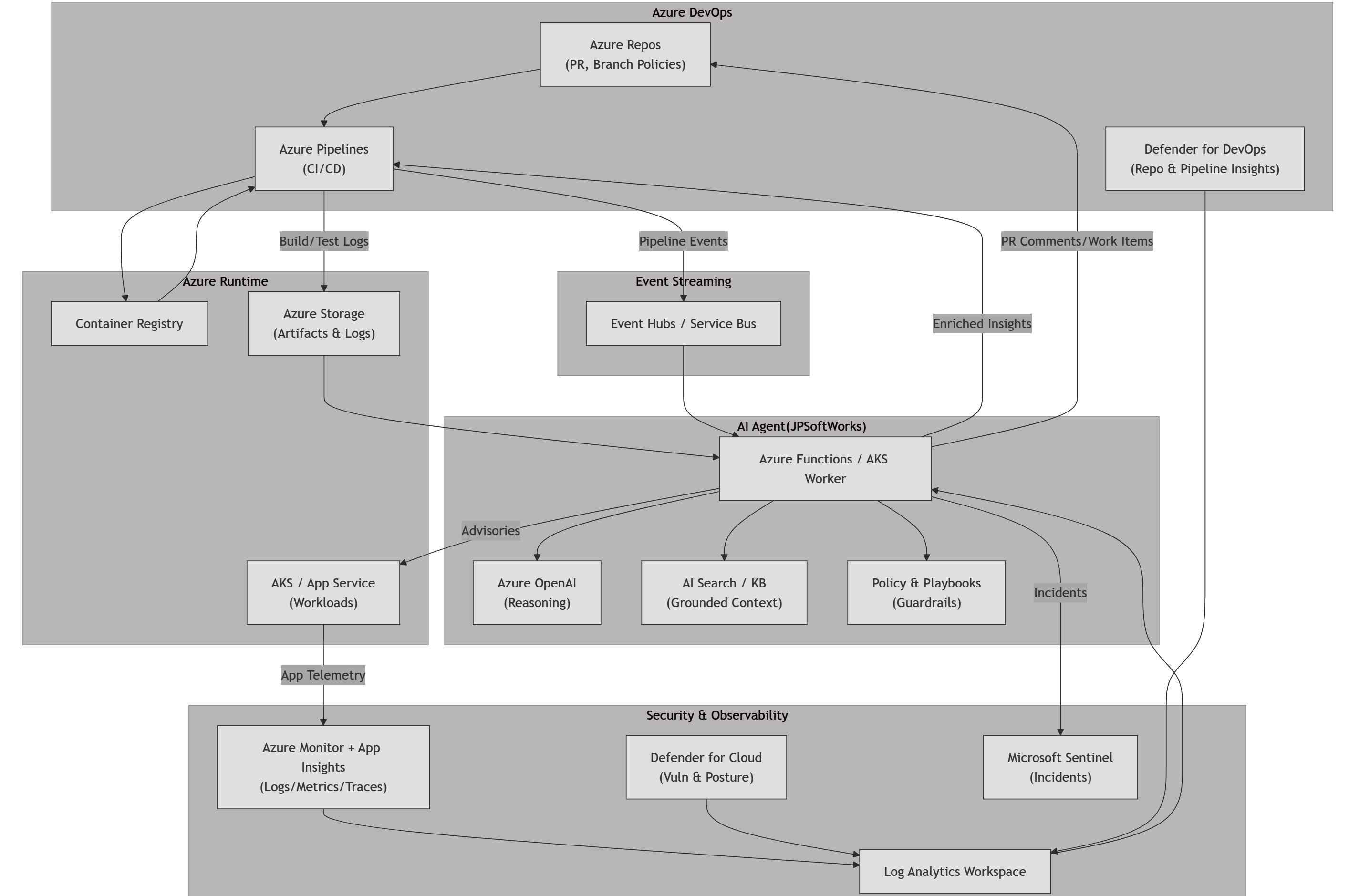
Our baseline looks familiar: Azure Repos or GitHub, Azure Pipelines for CI/CD, security gates for SCA/SAST/DAST, and deploys landing in Azure Kubernetes Service (AKS) or Azure App Service. Observability lives in Azure Monitor and Application Insights, with Defender for Cloud and Microsoft Defender for DevOps feeding risk signals. That stack is solid, but people still drown in information. The agent layer flips the script by doing three things for us:

  1. Enrich: Capture pipeline outputs, logs, and security findings; add context like recent commits, dependency diffs, infra drift, and change tickets.
  2. Correlate: Link symptoms to likely causes. For example, tie a spike in time-to-deploy to a newly added Helm hook, or associate a rise in false-positive vulns with a scanner rule update.
  3. Advise: Propose actions that fit our guardrails. That might be auto-opening a PR to tighten an Azure Policy, suggesting a change in test parallelism, or escalating a real incident to the right service team channel.

We place the AI agent on the event path that already exists in Azure:

  • Ingest: Azure Pipelines publishes build/test artifacts and logs to Azure Blob Storage; telemetry flows into Log Analytics via Azure Monitor and Application Insights. Security signals arrive from Defender for Cloud and Defender for DevOps.
  • Bus: We mirror key events to Event Hubs (or Service Bus) to keep the agent decoupled from the pipeline.
  • Agent runtime: A lightweight service on Azure Functions or a container in AKS subscribes to those events.
  • Reasoning + policies: The agent uses our in-house prompts, rules, and playbooks, and when we need LLM capabilities we call Azure OpenAI with strict grounding against our own knowledge base in Azure AI Search or a private storage account.
  • Action: The agent writes comments back to Azure DevOps (PR threads, pipeline summaries), creates Git branches with fixes, files ADO work items, or posts annotated alerts to Teams. For runtime issues it can open a Sentinel incident with enriched evidence.

What it changes for observability

  • From raw logs to narratives: Instead of five alerts in five tools, we get one narrative: “Deployment slowed by 34% since Aug 20 after adding OWASP ZAP to release stage; consider parallelizing scans or scoping targets.”
  • Trend awareness: The agent tracks moving baselines. When build time creeps 5% weekly for three weeks, we hear about it before we feel it.
  • Security prioritization: Findings get ranked by exploitability, exposure, and blast radius. A critical on a dead code path doesn’t jump the queue over a medium on an internet-facing service.
  • Feedback loops: The agent tests its own advice. If shortening log retention hurts forensics, it rolls back the recommendation and explains why.

A simple Azure blueprint

Here’s a minimal diagram we use to explain the pattern to teams. (click to expand)

Diagram


How we run it safely

  • Data boundaries first: The agent only sees what it must. We scope Log Analytics queries per service, and we route secrets through Key Vault. LLM calls are private, with prompt/response logging scrubbed.
  • Explain, then act: Advice is default; actions require either a runbook with pre-approved change types or explicit human approval in the PR or pipeline check.
  • Versioned knowledge: The playbooks that guide the agent are versioned like code and validated in non-prod pipelines.
  • Cost controls: We batch events, use Retrieval-Augmented Generation only when needed, and cache prior reasoning for repeated issues.

Day-one use cases

  1. Pipeline drift detector: Alert when stage order, conditions, or time budgets change materially; open a PR to restore standards.
  2. Noise reducer for security scans: Group duplicates, suppress known-benign families, and re-rank by exposure paths discovered from Azure Resource Graph.
  3. SLO watchdog: Watch error budgets from App Insights; if burn rate exceeds policy, the agent pauses risky deploys and proposes a rollback with links to failing traces.
  4. Dependency risk coach: When a new package lands, the agent checks support windows and transitive vulns, then proposes a safer alternative or pin strategy.

Bottom line: we keep our existing Azure stack. We just add an agent that listens harder, connects dots faster, and nudges us toward better decisions.

Wednesday, September 3, 2025

Vibe Coding: Are Humans an asset or a threat?

As usual, our people are our salvation


We’ve seen cybersecurity evolve: from basement script kiddies to AI-fueled threats. And yet as we enter late 2025, Alan Shimel’s article
 “Distraction is the New Zero‑Day: The Human Risk We Keep Ignoring” rings truer than ever. It’s not ransomware or deepfake scams causing the most damage: it’s good old distraction. According to KnowBe4 research, 43 % of breaches are traced back to employee distraction, outpacing training gaps (41 %), pressure to act fast (33 %), fatigue (31 %), and even the sophistication of the threats (17.1 %) (Security Boulevard).


That’s a stark reminder: no matter how advanced your tech, if people are juggling too much, security unravels.

Enter vibe coding: how some teams will distinguish themselves. It’s not just a buzzword. It’s code being co‑authored by AI copilots like Microsoft Copilot, Claude, or ChatGPT. This new paradigm has arrived, and it's not just changing how we write code: it’s shaking up how security must be woven in. After all, we aren't there to slow you down in your endeavors.

Our processes are our weapons.

Here’s how we bridge that gap:

  • Humans stay in control. AI is a tool, not an operator. It can craft and suggest: but accountability remains decidedly human.
  • Security belongs in the flow. AI accelerates development: but without thoughtful guardrails, it opens doors for blind spots. We bake in safe defaults, code reviews, prompts that call out risky patterns.
  • Awareness is the ultimate defense. In a distracted, hyper‑speed environment where AI suggestions flood the screen, our attention becomes the firewall. As Shimel cautions, distraction is the real zero‑day. Let’s guard against that, not just bug fixes.

At JPSoftWorks, we don’t just welcome vibe coding: we help organizations use it wisely. Because in a world where AI supports coding, the strongest security asset remains human intuition: if given the space, context, and tools to do its thing.

L'humain dans le "vibe coding": Un atout ou un risque additionnel?

L'les personnes à la rescousse


Nous avons vus la cybersécurité évoluer: from des pirates amateurs aux menaces IA. Mais fin 2025, l’article d’Alan Shimel "
Distraction is the New Zero‑Day : The Human Risk We Keep Ignoring" résonne clairement. Ce ne sont ni les ransomwares ni les deepfakes qui causent le plus de dégâts: c’est la distraction. D’après une étude KnowBe4, 43 % des incidents sont liés à la distraction des employés, quand le manque de formation atteint 41%, la pression 33%, l’épuisement 31%, et la sophistication des attaques seulement 17,1% (Security Boulevard, IT Pro).


Un signal fort: peu importe la robustesse de vos technologies, si les gens sont surchargés, la sécurité se fissure.

Voici comment nous abordons cela via le vibe coding, version 2025 chez JPSoftWorks: Ce n’est pas un simple terme tendance. C’est du code co-réalisé avec des copilotes IA comme Microsoft Copilot, Claude ou ChatGPT. Une nouvelle ère du développement est là, et elle impose de repenser la sécurité. Après tout on est pas là pour tenter de freiner vos élans.

Les processus sont nos défenses.

Notre approche :

  • L’humain garde la main. L’IA est un outil, pas un décideur. Elle peut suggérer ou rédiger: mais la responsabilité reste humaine.
  • La sécurité fait partie du flux. L’IA accélère l’écriture, mais sans garde-fous, elle laisse des angles morts. On intègre des prompts sûrs, des revues de sécurité, des configurations défensives.
  • La conscience humaine est la vraie protection. Dans un monde où la distraction nous guette et les suggestions IA pullulent, notre attention devient le pare-feu. Comme Shimel l’alerte, la distraction est la faille zéro. Préservons-la, pas seulement les patchs.

Chez JPSoftWorks, on ne se contente pas d’adopter le vibe coding: on aide les équipes à l’utiliser correctement. Parce que dans un monde où l’IA assiste le code, l’atout sécurité le plus solide reste l’intuition humaine: à condition qu’on lui donne l’espace, le contexte et les outils.

Friday, August 22, 2025

90 % d’économies avec 5 lignes de code!

L'IA dans SecDevOps: pourquoi les "hacks de coûts" ne sont pas toute l'histoire

Je lisais un article de towardsdatascience.com. Et il m'est venu à l'esprit que la plupart d'entre nous seraient tentés de se lancer dans cette situation à l'aveuglette. Voici mon point de vue, sur ce qui en est.

"Comment nous avons réduit les coûts de LLM de 90% avec 5 lignes de code". À première vue, ce genre d'histoire est captivant: cinq lignes de code, 90% d'économies, comment ne pas adorer?

Mais lorsque nous regardons les choses à travers le prisme de SecDevOps, le récit devient plus complexe. Le coût n'est pas la seule variable qui compte dans une pratique sûre, résiliente et fiable.


*L'image est générée par l'IA

La tentation des solutions rapides

L'article décrit comment les développeurs ont utilisé la troncage de "réponse" avec leurs modèles de langage à grande échelle (LLM) pour réduire l'utilisation des jetons et réduire les coûts. Cela fonctionne bien dans les expériences à portée étroite ou les POC (preuves de concept). Mais dans les environnements SecDevOps: où les systèmes de production gèrent des flux de travail critiques pour la sécurité : les gains rapides s'accompagnent souvent de risques cachés :

  • Angles morts opérationnels: Tronquer les réponses du modèle peut réduire les coûts, mais cela risque également de supprimer le contexte, les journaux ou les alertes de sécurité essentiels.
  • Les LLM dans les pipelines d'opérations de sécurité peuvent gérer la télémétrie sensible. Toute stratégie d'optimisation doit être validée par rapport à la confidentialité des données et à la conformité réglementaire.
  • Que se passe-t-il si une optimisation interrompt silencieusement un flux de travail de réponse aux incidents à 2 h du matin?

En bref: épargner 90% aujourd'hui ne signifie pas grand-chose si vous compromettez 99% de la confiance du système demain.

La perspective de SecDevOps

Lorsque nous introduisons des outils d'IA dans nos pipelines, que ce soit pour le triage des journaux, l'analyse de code ou l'aide à la décision en matière de sécurité, nous devons appliquer la même rigueur que nous apportons à toute autre technologie. 

Quelques principes directeurs :

  • Des mesures holistiques, pas seulement des coûts.
    Mesurez non seulement les économies d'argent, mais aussi l'exactitude de la réponse, la couverture de détection, le respect de la conformité et le temps de récupération des incidents.

  • Dépendances de l'IA de modélisation des menaces
    Chaque "optimisation" devient une nouvelle surface d'attaque. Par exemple: un attaquant pourrait-il exploiter la troncature de sortie pour cacher une activité malveillante dans les journaux?

  • Déploiement contrôlé
    Les techniques d'économie de coûts doivent d'abord être déployées dans des environnements non liés à la production (Dev > QA > Acceptance) avant d'atteindre la production: le même chemin discipliné que nous utilisons pour toute migration d'infrastructure en tant que code ou de base de données.

  • Vérifiabilité par défaut
    Nous ne nous contentons pas d'optimiser; nous documentons. Chaque changement dans la façon dont l'IA est utilisée dans les pipelines doit être vérifiable, versionné et sujet à annulation.

Application pratique dans les pipelines

Chez JPSoftworks, voici comment nous intégrerions une telle technique en toute sécurité dans un pipeline de sécurité CI/CD :

  1. Isoler les composants d'IA dans les services dockerisés 
     Assurez-vous que les demandes et les réponses de LLM sont transmises par un conteneur de services avec des limites, une journalisation et une surveillance appliquées.

  2. Contrôle centralisé des politiques
    Utilisez IaC (Bicep, Terraform) pour définir des politiques autour de l'interaction LLM: ycompris la troncature maximale des jetons et les catégories de données autorisées.

  3. Couche de vérification
    Introduire des étapes de validation (p. ex., somme de contrôle, vérifications d'exhaustivité basées sur les regex) avant que les systèmes en aval ne consomment la sortie du modèle tronqué.

Conclusion: Au-delà des 5 lignes de code

Les articles promettant des "économies de 90%" attirent l'attention: et ils devraient. Les coûts sont importants. Mais dans SecDevOps, le coût ne peut jamais être le seul axe d'optimisation. La sécurité, la fiabilité et la vérifiabilité doivent être de pair avec l'efficacité.

Chez JPSoftworks, nous croyons qu'il est important de permettre aux organisations d'adopter l'innovation sans compromettre la confiance. Les gains rapides sont les bienvenus, mais seulement lorsqu'ils sont bien intégrés dans les systèmes sécurisés et résilients qui assurent le fonctionnement des entreprises.

Liens (Anglais):
How We Reduced LLM Costs by 90% with 5 Lines of Code | Towards Data Science

Saving 90% of cost with five lines of code.


AI in SecDevOps: Why “Cost Hacks” Aren't the Whole Story

I was just reading an article by towardsdatascience.com. And it occurred to me that most of us would be tempted to jump into this pretty blindly. Here's my take on it.

“How We Reduced LLM Cost by 90% with 5 Lines of Code”. On the surface, this kind of story is exciting: five lines of code, 90% cost savings, what's not to love?

But when we look at it through the lens of SecDevOps, the narrative becomes more complex. Cost isn't the only variable that matters in a secure, resilient, and reliable practice.


*Picture is AI Generated


The Temptation of Quick Fixes

The article describes how developers used response truncation with large language models (LLMs) to reduce token usage and slash costs. This works well in narrowly scoped experiments or proof-of-concepts. But in SecDevOps environments: where production systems handle security-critical workflows: quick wins often come with hidden risks:

  • Operational Blind Spots: Truncating model responses might cut costs, but it also risks cutting out essential security context, logs, or alerts.
  • LLMs in security operations pipelines may handle sensitive telemetry. Any optimization strategy must be validated against data confidentiality and regulatory compliance.
  • What happens if an optimization silently breaks an incident response workflow at 2 a.m.?

In short: saving 90% today means little if you compromise 99% of system trust tomorrow.


The SecDevOps Perspective

When we introduce AI tooling into our pipelines: whether for log triage, code analysis, or security decision-support: we must apply the same rigor we bring to any other technology.

Some guiding principles:

  • Holistic Metrics, Not Just Cost.
    Measure not only dollar savings, but also response accuracy, detection coverage, compliance adherence, and incident recovery time.

  • Threat Modeling AI Dependencies
     Every “optimization” becomes a new attack surface. For example: could an attacker exploit output truncation to hide malicious activity in logs?

  • Controlled Deployment
    Cost-saving techniques should first roll out in non-production environments (Dev → QA → Acceptance) before reaching Production: the same disciplined path we use for any infrastructure-as-code or database migration.

  • Auditability by Default
    We don't just optimize; we document. Every change in how AI is used within pipelines must be auditable, versioned, and subject to rollback.


Practical Application in Pipelines

At JPSoftworks, here's how we would integrate such a technique safely into a CI/CD security pipeline:

  1. Isolate AI Components in Dockerized Services
     Ensure LLM requests and responses are mediated through a service container with enforced limits, logging, and monitoring.

  2. Centralized Policy Control
    Use IaC (Bicep, Terraform) to define policies around LLM interaction: including max token truncation and allowable data categories.

  3. Verification Layer
    Introduce validation steps (e.g., checksum, regex-based completeness checks) before downstream systems consume truncated model output.


Conclusion: Beyond the 5 Lines of Code

Articles promising “90% savings” capture attention: and they should. Cost matters. But in SecDevOps, cost can never be the only axis of optimization. Security, reliability, and auditability must stand shoulder to shoulder with efficiency.

At JPSoftworks, we believe in enabling organizations to embrace innovation without compromising trust. Quick wins are welcome: but only when they are integrated thoughtfully into the secure, resilient systems that keep businesses running.


Links:
How We Reduced LLM Costs by 90% with 5 Lines of Code | Towards Data Science

Théâtre de la sécurité infonuagique: pourquoi les "meilleures pratiques" d'Azure ne vous sécurisent pas réellement (Avec blogueur invité Joshua Copeland)

Seule, une "checklist" ne vaut rien. Joshua Copeland et Jean-Paul Lizotte Image générée par l'IA. Tout le monde aime...