Showing posts with label Governance. Show all posts

Monday, June 9, 2025

Why the “Dev(SEC)Ops Rockstar” Myth Persists


Why the “DevOps Rockstar” Myth Persists

A Bad­ging Bonanza for Ambitious Engineers

  • Instant credibility. One LinkedIn title change, and you’re the go-to guru for pipeline pain.
  • Tool-collector’s paradise. Kubernetes today, service mesh tomorrow—learning curves feel like career hacks.
  • Hero dopamine. Shipping hot-fixes at 2 a.m. earns high-five emojis and a reputation for “getting things done.”

An Irresistible Shortcut for Businesses

  • One neck to wring. Executives like simple org charts; a single “DevOps Department” feels efficient. (medium.com)
  • Budget sleight of hand. Blending Dev, Ops, and Sec into a single role avoids hiring three specialists, or so they believe.
  • Illusion of modernity. Saying “we’ve adopted DevSecOps” looks innovative in board decks: whether or not practices change.

The result? A fragile setup that contradicts DevOps’ founding principles of shared ownership and flow.


The Hidden Costs of the Hero Model

Risk Why It Hurts Data Point
Bus Factor = 1 One vacation, resignation or (heaven forbid) illness, stalls releases and repairs. The bus-factor concept warns that low redundancy is a project-killer. (en.wikipedia.org)
Bottlenecks & Burnout All changes queue behind a single reviewer/deployer or team. Elite teams ship 182× more often precisely because work is spread, not centralized. (multitudes.com)
Security Drift Late “security gates” create surprise blockers. Fixing a defect in prod costs up to 30× more than in dev. (linkedin.com)
AI Over-hype Super-charging one person with Gen-AI increases batch size and failure risk. A 25 % jump in AI use correlates with -1.5 % throughput and -7.2 % stability. (cloud.google.com)

None of this is sustainable; it just hides toil until it explodes.


DevOps & SecDevOps Done Properly

“High-performing teams are cross-functional, platform-enabled, and metrics-driven.”: DORA 2024

  1. Shared Responsibility. Developers own runtime; operators code infrastructure; security writes policies as code.
  2. Platform Engineering. A small team curates paved-roads (templates, golden images, self-service portals).
  3. Shift-Left Security. Static analysis, secret scanning, and policy-as-code fire on every pull request.
  4. Continuous Learning. Blameless post-mortems feed dashboards and backlog grooming.
  5. Data-Driven Improvement. Track Lead-Time, Deployment Frequency, MTTR, and Change-Fail Rate, not vanity stats. Elite performers beat laggards by 1-2 orders of magnitude on all four. (multitudes.com)

Cross-functional teams with these traits are 50 % more likely to succeed. (moldstud.com)

Tuesday, June 3, 2025

DevOps versus DevSecOps, an illustrated example.

So what’s the big deal about DevSecOps?

Why can’t you just explain it?
I can, but first we need to talk about DevOps.

Act I – DevOps, the culture. Not a person.

Contrary to many job ads, DevOps isn’t a title. It’s a way of working that dissolves the wall between those who build software and those who run it. Think of it as a kit of good habits:

  • Shared ownership: Dev and Ops solve problems together.
  • Automation: Let the pipeline handle repeatable work so humans focus on value.
  • Continuous feedback: Ship small, ship fast, break less.
  • Process before product: Tools only matter if they fit the people and the flow.

Teams that embrace this cultural shift ship faster and with fewer outages: something the DORA State of DevOps reports have measured for years.[1]

Rule of thumb
Do the right thing at the right time.
Simple to say, tricky to master.

Act II – Adding the SEC

All we do is extend the same mindset: if Ops belongs in the conversation from day one, so does Security. DevSecOps weaves security controls, tests and governance into every stage of the pipeline instead of treating them like an end-of-cycle audit.[2]

Act III – A walk through the pipeline

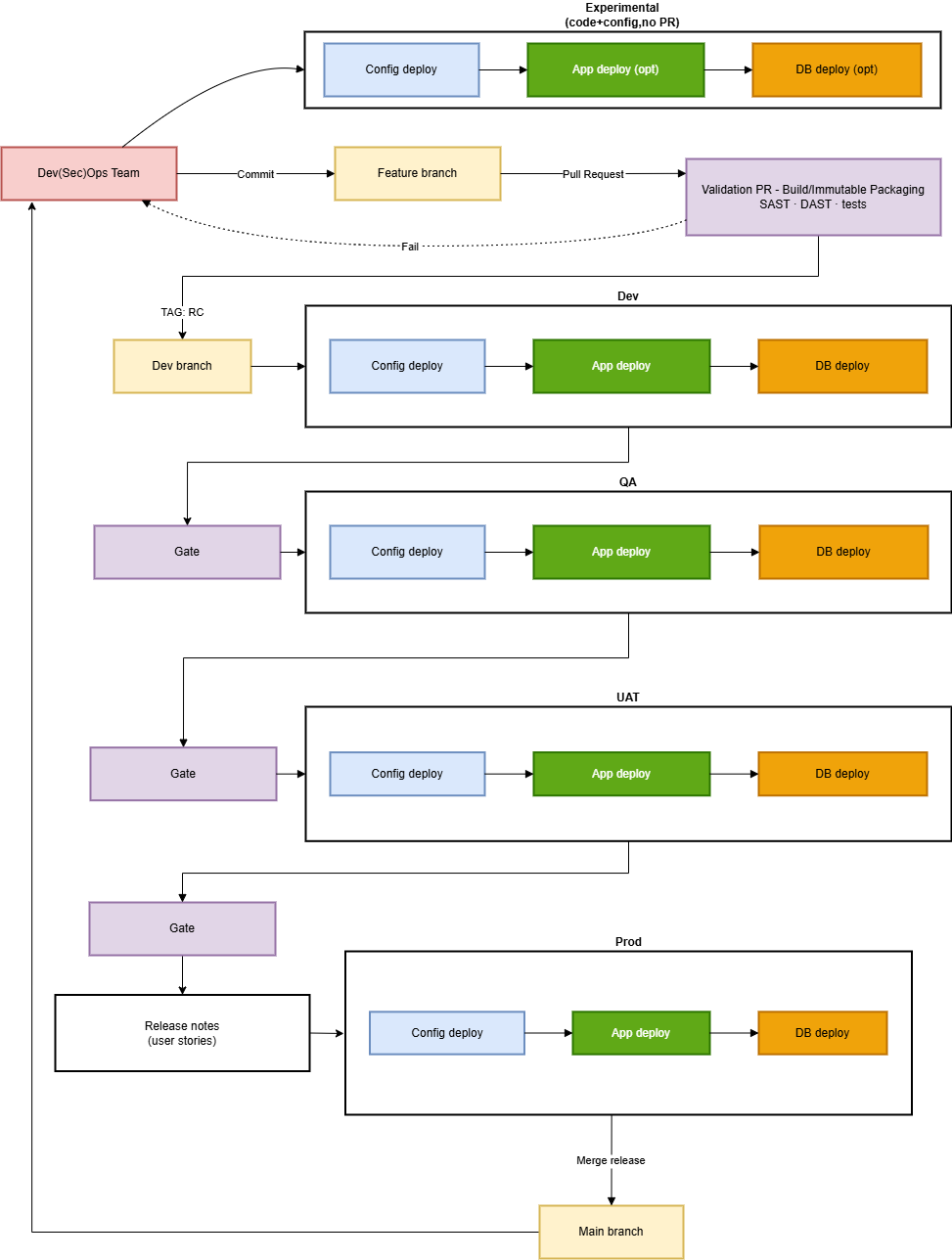
(Click the picture to enlarge.)


Figure 1 – Sample Dev + Sec + Ops pipeline.
Stage Why it exists Who it shields
Experiment Fail fast on a branch or local sandbox. Literally everyone else.
Dev Prove the change plays well with codebase, config & IaC. Fellow engineers, OPS.
QA Automated & exploratory tests, data seeding, basic gates. Testers and early adopters.
UAT Mirror prod as closely as budgets allow; performance & business acceptance. Business stakeholders.
Prod Final gate, release notes, infra diffs. Real customers & revenue.

Security questions ride along:

  • Experiment → Dev – Static analysis, secret scanning.
  • Dev → QA – Dependency checks, container image signing.
  • QA → UAT – Dynamic (DAST) tests, infra-drift detection.
  • UAT → Prod – Compliance artefacts, runtime policy enforcement, configuration concerns.

We didn’t add environments: we baked security into the ones we already have.

Act IV – The big DevSecOps change.

Ready for the twist?

We change … nothing.

Stages, people and cadence stay the same. What changes is the definition of done. Security requirements become first-class citizens—groomed, coded, tested and deployed beside features. It feels almost boring, which is exactly the point: security becomes routine, not roulette.

Conclusion – Why this matters, now!

  • High-performing teams that couple culture, automation and security outperform their peers on stability and speed.[1]
  • Regulators and customers expect proof of software supply-chain hygiene, continuously.
  • Talent retention improves when Ops & Security aren’t firefighting at 2 a.m.

Your call to action

  1. Invite security to the daily stand-up. Today. Zero slide decks required.
  2. Automate one pain-point. 
  3. Add one security gate: OwaspSAST, SCA or container scan, before the next sprint review.
  4. Share this article with a teammate and ask what “doing the right thing at the right time” means to them.

DevSecOps isn’t a new religion; it’s DevOps done right. Start small, iterate, and let security become as invisible, and indispensable as, version control.

Ready to drop that wall for good? Let’s ship, safely. Questions let's have it below.


References

  1. Google Cloud / DORA – State of DevOps Reports
  2. Red Hat – What is DevSecOps?
  3. AWS – DevSecOps Explained

© 2025 JPSoftWorks. All rights reserved.

DevOps et SecDevOps version illustrée

Alors, c’est quoi "la grosse affaire" avec DevSecOps ?

Pourquoi est-ce si difficile à expliquer ?
Je peux le faire, mais parlons d’abord de DevOps.

Acte I – DevOps, la culture qu’on ne peut pas simplement "embaucher"

Contrairement à bien des offres d’emploi, DevOps n’est pas un titre ou un rôle. C’est une façon de travailler qui fait tomber le mur entre celles et ceux qui créent les logiciels et celles et ceux qui le font tourner, qui l'exploitent. Pensez à DevOps comme si c'était un ensemble de bonnes habitudes :

  • Responsabilité partagée: Dev et Ops résolvent les problèmes ensemble.
  • Automatisation: Le pipeline prend en charge le répétitif ; les humains se concentrent sur la valeur.
  • Rétroaction continue: Livrer petit et vite, c’est moins risqué que tout livrer d’un coup.
  • Le processus avant l’outil: Les outils ne comptent que s’ils servent l’équipe et son flux.

Les équipes qui adoptent ce changement culturel livrent plus vite et avec moins d’incidents, comme le démontrent les rapports DORA State of DevOps année après année.[1]

Règle d’or
Faire la bonne chose au bon moment.
Simple à dire, difficile à maîtriser.

Acte II – Ajouter le SEC

On étend la même logique : si Ops est dans la discussion dès le jour 1, la Sécurité y a sa place aussi. DevSecOps intègre contrôles, tests et gouvernance de sécurité à chaque étape du pipeline, au lieu d’un audit final hors délais.[2]

Acte III – Parcours du pipeline

(Cliquez sur l’image pour l’agrandir .)

Figure 1 – Exemple de pipeline Dev + Sec + Ops.
Étape Pourquoi elle existe Qui elle protège
Expérimentation Échouer vite sur une branche ou dans un bac à sable local. Pratiquement tout le monde.
Dev Vérifier l’intégration avec le code, la config et l’IaC. Les autres ingénieurs.
QA Tests automatisés et exploratoires, jeux de données, portes de contrôle. Testeurs et premiers utilisateurs.
UAT Imiter la prod autant que le budget le permet ; perf. et validation métier. Parties prenantes d’affaires.
Prod Dernière porte, notes de version, écarts d’infrastructure. Clients réels et revenus.

Les questions de sécurité voyagent avec l’application :

  • Expérimentation → Dev — Analyse statique, détection de secrets.
  • Dev → QA — Vérif. de dépendances, signature d’images conteneurs.
  • QA → UAT — Tests dynamiques (DAST), détection de dérive infra.
  • UAT → Prod — Artefacts de conformité, politiques à l’exécution.

Nous n’avons pas ajouté d’environnements: nous avons "scotché" la sécurité dans ceux qui existaient déjà.

Acte IV – Le grand changement DevSecOps.

Prêt·e pour le punch ?

On ne change… rien.

Les étapes, les gens et la cadence restent les mêmes. Ce qui change, c’est la définition de “fait” (Definition of done, ou DoD). Les exigences de sécurité deviennent des citoyens de première classe: planifiées, codées, testées, déployées avec les fonctionnalités. Ça paraît presque ennuyeux ; c’est justement le but : la sécurité devient routine, pas roulette russe.

Conclusion – Pourquoi c’est crucial maintenant

  • Les équipes qui combinent culture, automatisation et sécurité surpassent leurs pairs en stabilité et vitesse.[1]
  • La gouvernance, les lois et les clients exigent désormais une hygiène de la chaîne de livraison logicielle, en continu.
  • La rétention des talents s’améliore quand Ops et Sécurité ne sont pas en mode incendie à 2 h du matin.

Votre appel à l’action:

  1. Invitez la sécurité au stand-up quotidien. Dès aujourd’hui. Pas besoin de diapos.
  2. Automatisez une "épine dans le pied"
  3. Ajoutez un seul contrôle de sécurité: Owasp, SAST, SCA ou scan de conteneur, avant la prochaine revue de sprint.
  4. Partagez cet article avec un·e collègue et demandez-lui ce que « faire la bonne chose au bon moment » signifie pour elle ou lui.

DevSecOps n’est pas une nouvelle religion ; c’est du DevOps bien fait. Commencez petit, itérez, et laissez la sécurité devenir aussi invisible, et indispensable, que Git.

Prêts·es à faire tomber le mur pour de bon ? Livrons, en toute sécurité. Laissez vos question ci-bas!


Références

  1. Google Cloud / DORA – Rapports « State of DevOps »
  2. Red Hat – Qu’est-ce que DevSecOps ?
  3. AWS – DevSecOps expliqué

© 2025 JPSoftWorks. Tous droits réservés.

Monday, June 2, 2025

SecDevOps ou pas SecDevOps? C'est même pas une question!

SecDevOps + Zero-Trust : guide coquin pour les équipes qui « font déjà du DevOps »… ou pas !

TL;DR  On ne cherche pas à remplacer DevOps; on l'enveloppe dans une armure fluo qui bloque ou révèle le risque, tout en laissant la gang à l’intérieur danser comme si c'etait 1999.


Qu’est-ce que SecDevOps, au juste ?

  • DevOps : faire circuler la valeur vite, apprendre, recommencer (« vraiment TLDR »).
  • SecDevOps : même chose, mais on branche des capteurs de risques dans la plomberie pour que le danger avertit avant de mordre. (Encore plus de shift-left !)
  • Zero-Trust : « Ne jamais faire confiance, toujours vérifier »… appliqué aux paquets, jetons, conteneurs, bref tout SAUF l’intention de vos collègues. Réseaux parano: humains optimistes.

Ensemble, ça donne un modèle de capacités qui se branche sur Scrum, Kanban, GitOps, SAFe, peu importe le beat que votre organisation suit, sans exiger une nouvelle religion.


Les quatre principes (gentiment) irrévérencieux

  1. Tout ce qui bouge est journalisé, scanné ou sinon gueulé. Commits, conteneurs, changements IAM, on s’en fiche de qui a appuyé sur Enter.
  2. Les garde-fous valent mieux que les gates (non, pas celles de Bill !). Une image de base endurcie évite bien des « oups »; un gros bouton rouge « ÉCHEC » un vendredi 16 h, ça fait grincer des dents.
  3. Zero-Trust du système, confiance totale envers les humains (au boulot). On fait tourner les jetons aux heures, mais on fait tourner le blâme hors du post-mortem.
  4. La visibilité = l’amour (gardez quand même vos vêtements). Si un risque peut se cacher, un succès aussi. Les tableaux de bord montrent le flux et les lacunes côte à côte. Les équipes avec une vraie sécurité psychologique et de bons métriques DORA surclassent leurs pairs.

Ça remplace DevOps ?

Ben non, c’est DevOps PLUS.
Imaginez DevOps comme un téléphone intelligent ; SecDevOps est l’étui blindé extra-robuste. Vos apps préférées tournent toujours, mais l’appareil survit aux chutes, aux cafés renversés et au hacker occasionnel.

Constat terrainQuoi faire
Vous avez déjà un CI/CDGreffez les contrôles de sécurité dans les mêmes étapes. Gardez la culture du "green bar", ajoutez juste une touche de violet pour les passes à la sécurité.
Les Ops craignent la surchargeAutomatisez d’abord, annoncez ensuite. Si le scanner réussit en silence 99 % du temps, personne ne crie.
La Sécurité redoute le « Far West »Offrez-leur des tableaux de bord en lecture seule et un droit de veto sur les exceptions, les changements non-documentés, pas sur chaque déploiement.

Zero-Trust sans casser l’ambiance

Pilier Zero-Trust Traduction « humaine-friendly » Garde-fou pas gossant
Vérifier explicitement « On te fait confiance… mais on double-vérifie le système. » Toutes les requêtes API se ré-authentifient en douce; les échecs s’affichent à côté du compte de tests unitaires.
Moindre privilège « Un plus petit rayon d’explosion = moins d’appels à 3 h du mat. » Rôles « PIM » de 2 heures; l’audit se publie dans #sec-télémétrie.
Présumer l’intrusion « Curiosité plutôt que blâme. » Jeux de guerre trimestriels : fuite de faux secrets, beignes pour les gagnants, pas de recherches de coupables.

Starter kit (sprint d’une journée: avec zéro échantillon de code, promis !)

  1. Activez les scanners intégrés. GitHub Advanced Security, SAST GitLab, analyseurs Azure DevOps, SonarQube… prenez ce que votre dépôt offre déjà gratuitement.
  2. Montez un « Risk Radiator ». Un panneau Grafana interne qui fusionne déploiements, vulnérabilités et incidents en une vue bien bruyante et fière.
  3. Activez les rôles Just-In-Time. Utilisez la fonction JIT/PIM de votre cloud pour que n’importe quel·le coéquipier·ère obtienne un accès temporaire sans passer par le service desk.
  4. Planifiez une journée Purple-Team.* Un après-midi, simulez une fuite de jeton et exercez-vous à la trouver et à la corriger ensemble. Top-là: obligatoire.
*Bleu + Rouge = Purple (Violette) au cas ou c'est pas clair...

Métriques qui comptent (et qui gardent tout le monde honnête)

FluxSécuritéCulture
Gestion du changementMTTR-V (correction des vulns)Nb d’humains uniques ayant fermé un billet sécurité
Fréquence de déploiement% de sessions privilégiées qui expirent autoNb de « kudos » pour détection de risque précoce
Points d’histoire livrésNouvelles mesures de sécurité mises en placeAmélioration continue documentée

Si un indicateur monte les équipes l’une contre l’autre, digérez le et jetez-le. S’il déclenche la collaboration, gardez-le.


Dernier mot

SecDevOps + Zero-Trust complète DevOps comme la ceinture de sécurité complète la voiture sport : la balade reste délirante, les accidents font moins mal, et personne ne prétend que la ceinture « remplace » le moteur.

Lancez-vous avec un scanner de vulnérabilités, un tableau de métriques et PIMez vous. Laissez les données parler, laissez les humains rire, et observez la vélocité sécuritaire devenir la nouvelle norme.

Allez hop! Ajoutez cette étincelle violette à vos pipelines, votre futur vous vous dira merci.

Vous voulez en parler? Pour en savoir plus? Contactez-nous, dans la section des commentaires ci-dessous.

To SecDevOps or not to. It isn't even a question.

SecDevOps + Zero-Trust: a Cheeky Field Guide for Teams That Already “Do DevOps”...or dont...

TL;DR — We’re not trying to replace DevOps, we’re giving it a shiny exoskeleton that blocks or exposes risk and still lets the people inside, boogie like it's 1999.


What is SecDevOps, Really?

  • DevOps: make value flow fast, learn, repeat. really TLDR.

  • SecDevOps: do the same thing but wire risk-sensors into the plumbing so danger lights up before it bites. (Shift left... again)

  • Zero-Trust: “Never trust, always verify”… applied to packets and tokens, code, containers, everything, EXCEPT colleagues’ motives. In other words, paranoid networks, optimistic humans. (NIST, csrc.nist.gov)

Put them together and you get a capability model that snaps onto Scrum, Kanban, GitOps, SAFe, whatever rhythm your org already claps to, without demanding a brand-new religion.


The Four Cheeky Principles

  1. Everything That Moves Is Logged, Scanned, or Yelled At
    Commits, containers, IAM changes, doesn’t matter who hit Enter.

  2. Guardrails Beat Gates (no, no, not Bill!)
    A pre-hardened base image prevents oopsies; a red “BLOCKED” button at 4 p.m. Friday enrages engineers.

  3. Zero-Trust the System, Full-Trust the Humans, at work.
    We rotate tokens every hour but rotate blame out of the post-mortem.

  4. Visibility = Love (Keep your clothes on, though)
    If a risk can hide, so can a win. Dashboards show flow and flaws side-by-side. Elite teams with strong psych-safety and good metrics outperform their peers on every DORA KPI. (InfoQ, Kodus)


Does This Replace DevOps?

Nope, ­it’s DevOps Plus.
Think of DevOps as the smartphone; SecDevOps is the ruggedized case and screen protector. Your favourite apps still run, but the device survives drops, spills, and the occasional hacker.

Reality Check What to Do
You already have CI/CD Bolt security checks into the same pipeline stages. Keep the green bar culture, just add a “purple sparkle” for security passes. (explanation forthcoming)
Ops teams worry about extra toil Automate first, announce second. If the scanner’s silent-success rate is 99 %, nobody screams.
Security fears a “Wild West” Give them read-only dashboards and veto power on exceptions and undocumented changes, not on every deploy.

How Zero-Trust Fits Without Killing the Vibe

Zero-Trust Pillar Human-Friendly Translation Non-Annoying Guardrail
Verify Explicitly “We trust you, we double-check the system.” All API calls re-auth transparently; failure shows up next to the unit-test count.
Least Privilege “Smaller blast-radius = fewer 3 a.m. calls.” 2-hour click-to-elevate roles; audit trail posts to #sec-telemetry.
Assume Breach “Curiosity over blame.” Quarterly game-days inject fake secrets; winners get doughnuts, not finger-pointing.


Starter Kit (One-Day Sprint, No Code Samples: Promise!)

  1. Turn On Built-In Scanners
    GitHub Advanced Security, GitLab SAST, Azure DevOps Analyzers, SonarQube, or whatever your repo already gives you for free.

  2. Spin Up a “Risk Radiator”
    Internal Grafana panel that glues deployment, vulnerability, and incident metrics into one loud, proud place. Keep granular data about projects for diagnostics, but display the aggregate.

  3. Enable Just-In-Time Roles
    Use your cloud’s JIT/“break-glass”/PIM feature so any teammate can get short-lived access without service-desk limbo.

  4. Schedule a Purple-Team* Game-Day
    One afternoon, fake a token leak and practise finding & fixing it together. High-fives mandatory.

*Red+Blue = Purple, in case you needed the explanation

Metrics That Matter (and Keep Everyone Honest)

Flow Safety Culture
Lead Time for Change MTTR-V (vuln fix) # of unique humans who closed a security ticket
Deployment Frequency % privileged sessions auto-expire # shout-outs for spotting a risk early
Story points delivered New safety measures put into place continuous improvement

If a stat can pit teams against each other, digest it and dump it. If it sparks joint problem-solving, keep it.


Final Nudge

SecDevOps + Zero-Trust complements DevOps the way seatbelts complement sports cars: the ride stays thrilling, the crashes hurt less, and nobody argues that belts “replace” engines.

Start with one scanner, one metric board, and one JIT role.
Let the data speak, let the humans laugh, and watch safe velocity become the new normal.

Now go forth and add that purple sparkle to your pipelines: your future self already thanks you.

Want to talk about it? To know more? Hit us up, in the comment section below.

Sunday, June 1, 2025

Faire "Agile" de la bonne façon : les points et le contrat.

Au-delà des chiffres: Comprendre les Story Points comme un contrat tacite dans Azure DevOps: Adopter l'observabilité & SecDevOps

Introduction: Mise en contexte

Soyons honnêtes: l'idée des "story points" peut sembler un peu… eh bien, absurde au premier abord. C'est comme essayer de mesurer le ressenti d'une bonne tasse de café avec une règle. Mais les story points ne visent pas une mesure précise. Ils sont un outil de communication, de collaboration et, surtout, de compréhension de la complexité relative des tâches. Mais, si on les fait correctement, il ne s'agit pas de mesurer le temps ; il s'agit de tenir une promesse. Une promesse tacite, en fait, celle qu'on fait d'un coup d'œil complice et d'un haussement d'épaules un peu embarrassé. Il s'agit d'estimer l'effort, pas le temps. Utiliser les story points nous permet de prioriser efficacement et de suivre notre vélocité: en gros, à quelle vitesse nous avançons. C'est une approche étonnamment utile et c'est une pierre angulaire du DevSecOps.

L'écosystème interconnecté: Observabilité & SecDevOps

Imaginez un orchestre chaotique: où chacun joue un instrument différent, à n'importe quel cadence et où personne ne sait ce que font les autres. C'est à ça que ressemble le développement d'application sans un bon système. Azure DevOps, en revanche, ressemble à une symphonie magnifiquement orchestrée. Azure Boards (pour la planification), Azure Repos (pour le code), Azure Pipelines (pour les compilations et les déploiements) et Azure Artifacts (pour la gestion des packages): ils communiquent tous ensemble. Les changements dans le plan sont immédiatement reflétés dans le code, les compilations et les déploiements. Cela crée une boucle de rétroaction: un élément essentiel pour l'observabilité.

Voyez les choses de cette façon: un petit bug introduit pendant une compilation est immédiatement signalé, et l'équipe peut rapidement annuler les modifications. C'est un principe fondamental du SecDevOps: la sécurité proactive, la surveillance continue et la réponse rapide. Sans cette intégration, vous êtes essentiellement à l'aveugle. C'est comme essayer de réparer une fuite de canalisation, mais cette fois-ci avec une lampe de poche. La visibilité en temps réel est essentielle !

Observabilité et SecDevOps: Maintenir le contrat vivant

Sans observabilité, la capacité à comprendre ce qui se passe à l'intérieur de votre système, ce contrat tacite est fragile. Vous devez savoir pourquoi les choses se produisent. La surveillance, la journalisation et le traçage sont vos alliés. Les pratiques SecDevOps ne consistent pas seulement à ajouter de la sécurité ; elles visent à construire la résilience et la compréhension. C'est autant une question de manière de travailler que de ce que nous livrons !

Alors, qu'est-ce qu'une User Story ? (Et pourquoi c'est un accord secret)

Une user story, au fond, est un petit extrait de conversation. Ce n'est pas un document de spécification détaillé. Ce n'est pas un plan. C'est un point de départ. Une bonne user story ressemble à ceci: "En tant que [rôle utilisateur], je veux [objectif] afin que [bénéfice]." Exemple: "En tant que client, je veux pouvoir réinitialiser mon mot de passe afin de pouvoir accéder à mon compte si je l'oublie." Simple, non ?
Mais voilà le truc: ce ne sont pas seulement les mots. C'est l'accord implicite qui suit. C'est là que le côté "tacite" entre en jeu. C'est comme accepter de se voir pour un café: vous n'écrivez pas l'itinéraire exact, la température ou la marque de café préférée. Vous acceptez simplement de vous retrouver. Puis, vous vous débrouillez. Une user story bien rédigée est la base de cet accord.

L'art de moins de stress, plus de promesses

La documentation agile, et je ne parle pas d'un dossier de 100 pages, je parle de tout ce que l'on place simplement dans nos tableaux de travail, vise en réalité à réduire la pression sur l'équipe. Soyons réalistes, courir sans cesse après cette "spécification parfaite" ne fait qu'engendrer de l'anxiété. C'est un jeu de raffinement sans fin, et honnêtement, c'est épuisant. En adoptant une approche légère, on déplace l'accent de la documentation méticuleuse de chaque détail vers la simple capture d'assez d'informations pour que tout le monde reste aligné. Il s'agit d'une compréhension partagée, pas d'un contrat rigide.

Les éléments qui "verrouillent" la spécification (et pourquoi vous ne devriez pas les ignorer)

Décomposons ce qui fait réellement qu'une user story "tient". C'est plus que le format de base. Voici ce qui doit être présent pour que tout le monde soit sur la même longueur d'onde et pour créer cet accord puissant et silencieux :

  • Critères d'acceptation: Ce sont les règles de l'accord. Ce sont les éléments qui doivent être vrais pour que la story soit considérée comme "terminée". Ils ne sont pas optionnels. Exemple: "Étant donné que j'ai saisi une adresse e-mail valide, lorsque je clique sur ‘Réinitialiser le mot de passe', alors je devrais recevoir un e-mail avec un lien pour réinitialiser mon mot de passe."
  • Définition de Terminé (DoD): C'est la liste de contrôle plus large: scans de sécurité, revues de code, tests d'intégration, etc. C'est ce qui assure que la story est véritablement complète et fiable.
  • Valeur d'affaires": C'est la partie "… afin que …". C'est pourquoi nous faisons cela. C'est le lien avec l'objectif "business". Sans cela, vous construisez seulement des belles choses creuses sans but.
  • Considérations techniques: Parfois, l'équipe doit discuter des implications techniques. Ce n'est pas nécessairement une partie de la user story, mais il est important de le reconnaître.

Story Points: Engagements, pas échéances

Oubliez l'idée de mapper les story points aux heures. C'est une recette pour la frustration. Les story points sont des estimations relatives: parlons-nous d'une "petite modification" ou d'une "refonte majeure" ? Considérez-les comme un moyen de communiquer la complexité relative et le risque. Encore une fois, nous n'essayons pas de quantifier l'effort (c'est un piège !). Nous essayons d'établir une mesure relative de complexité et de risque. Une story estimée à environ 8 points est à peu près aussi complexe qu'une story à 13 points. L'important n'est pas le chiffre lui-même, mais la compréhension partagée qu'il représente.

La règle des 13 points: Quand décomposer

Voici un petit secret: tout ce qui est estimé à 13 ou plus devrait probablement être décomposé. Sérieusement. C'est un signal d'alarme rouge flamboyant qui vous dit que vous vous apprêtez à vous lancer dans quelque chose de potentiellement épineux. Les stories volumineuses sont souvent le symptôme d'un glissement de périmètre ou d'un manque de clarté.

Voyez les choses ainsi: si vous estimez une story à 13 points, vous dites essentiellement "Je ne suis pas tout à fait sûr de ce dans quoi je m'embarque." Et c'est tout à fait correct ! Mais cela doit être traité. Ne vous contentez pas de la confier à un développeur et d'espérer le meilleur.

La séquence de Fibonacci: Pourquoi une échelle relative ?

Vous avez probablement entendu l'histoire de Ron Jeffries et de la séquence de Fibonacci. Il essayait d'estimer l'effort sur un projet, et il s'est rendu compte que les tâches se répartissent souvent en catégories distinctes: certaines sont minuscules, d'autres énormes. La séquence (1, 2, 3, 5, 8, 13…) est une façon naturelle de représenter cela. C'est comme dire "D'accord, cette tâche est à peu près de la taille d'un petit chien, celle-ci est de la taille d'un Labrador…"

La valeur d'un point: Échelle, pas absolus

Ne tombez pas dans le piège de penser qu'un "3" signifie toujours la même chose. Lors du Sprint 1, un "3" peut être une entreprise énorme: réécrire une partie conséquente de l'application. Mais au Sprint 5, c'est probablement une tâche standard. La valeur d'un point se solidifie avec le temps à mesure que l'équipe acquiert de l'expérience et une compréhension partagée. Il s'agit de suivre la vélocité: la tendance de la rapidité avec laquelle vous avancez, pas d'un objectif rigide. Considérez cela ainsi: un marathonien expérimenté connaît mieux son rythme qu'un débutant.

Rigueur et flexibilité: Trouver l'équilibre

Bien qu'il soit important d'être réfléchi dans nos estimations, ne vous enfoncez pas dans les détails. La rigueur et la flexibilité doivent être équilibrées. Utilisez des techniques comme les rétrospectives de sprint et le planning poker pour affiner vos estimations au fil du temps. Adoptez l'auto-organisation et l'adaptation. N'oubliez pas que l'objectif est de communiquer efficacement et de délivrer de la valeur.

Azure Boards, Repos, Pipelines, Artifacts: Construire les "dents"

C'est là que la magie opère. Lorsque vous connectez vos Azure Boards, vos Git Repos, vos Pipelines et vos Artifacts, vous intégrez les dents dans ce contrat tacite.

  • Azure Boards: Fournit le cadre pour la story, le backlog et la planification du sprint.
  • Repos: La source de vérité pour le code.
  • Pipelines: Automatisent le processus de compilation, de test et de déploiement, garantissant une livraison cohérente.
  • Artifacts: Le livrable empaqueté, prêt à être déployé.

Cet écosystème intégré transforme une promesse vague en un résultat concret et vérifiable. Les pratiques de sécurité et DevOps (SecDevOps) sont cruciales ici. Pensez aux scans de sécurité automatisés dans vos pipelines, aux évaluations de vulnérabilité et à la surveillance continue.

Conclusion

En résumé: Les story points ne servent pas à mesurer le temps. Ils visent à instaurer la confiance, à favoriser la collaboration et à transformer des intentions vagues en résultats concrets. En connectant vos outils et en adoptant SecDevOps, vous pouvez transformer votre processus agile d'une série de suppositions en un pipeline de livraison fiable et reproductible.

Et en fin de compte, les story points sont un outil de communication et de collaboration, pas un système de mesure rigide. Adoptez l'approche du "contrat tacite": mettez l'accent sur la compréhension partagée et laissez les chiffres vous guider. Ne vous focalisez pas sur les chiffres ; concentrez-vous sur la livraison de la valeur.

Prêt à transformer vos pratiques DevSecOps ? Laissez-nous un commentaire ci-dessous pour planifier une consultation et découvrir comment nous pouvons vous aider à construire une équipe plus efficace et collaborative.

Prochainement: SecDevOps et Ingénierie de Plateforme.

Doing Agile the right way: Points and the contract.

Beyond the Numbers: Understanding Story Points as a Tacit Contract in Azure DevOps: Embracing Observability & SecDevOps

Introduction: Setting the Stage

Let's be honest: the idea of "story points" can feel a bit…well, absurd at first. It’s like trying to measure the feeling of a good cup of coffee with a ruler. But story points aren’t about precise measurement. They're a tool for communication, collaboration, and crucially, understanding the relative complexity of tasks. But, if we're doing them right, they're not about measuring time; they're about making a promise. A tacit one, mind you, the kind you make with a knowing glance and a slightly uncomfortable shrug. They’re about estimating the effort, not the time. Using story points allows us to prioritize effectively and track our velocity: essentially, how quickly we're moving forward. It’s a surprisingly useful approach, and it’s a cornerstone of DevSecOps.

The Interconnected Ecosystem: Observability & SecDevOps

Imagine a chaotic orchestra where everyone is playing different instruments, and no one knows what the others are doing. That’s what development can be without a good system. Azure DevOps, however, is like a beautifully orchestrated symphony. Azure Boards (for planning), Azure Repos (for code), Azure Pipelines (for builds and deployments), and Azure Artifacts (for managing packages): they all talk to each other. Changes in the plan are immediately reflected in the code, builds, and deployments. This creates a feedback loop: a crucial element for observability.

Think of it this way: a small bug introduced during a build is immediately flagged, and the team can quickly roll back the changes. This is a fundamental principle of SecDevOps: proactive security, continuous monitoring, and rapid response. Without this integration, you’re basically flying blind. It’s like trying to fix a leaky pipe, but this time with a flashlight. Real-time visibility is key!

Observability and SecDevOps: Keeping the Contract Alive

Without observability, the ability to understand what's going on inside your system, that tacit contract is fragile. You need to know why things are happening. Monitoring, logging, and tracing are your friends. SecDevOps practices aren't just about adding security; they're about building resilience and understanding. As much about how we work than what we deliver!

So, what's a User Story Anyway? (And Why It's a Secret Agreement)

A user story, at its heart, is a little snippet of a conversation. It's not a detailed specification document. It's not a blueprint. It's a starting point. A good one looks something like this: "As a [user role], I want [goal] so that [benefit]." Example: "As a customer, I want to be able to reset my password, so that I can access my account if I forget it." Simple, right?
But here's the thing: it's not just the words. It's the implicit agreement that follows. That's where the "tacit" part comes in. It's like agreeing to meet for coffee, you don't write down the exact route, the temperature, or the preferred brand of coffee. You just agree to meet. And then, you figure it out. A well-crafted user story is the basis of that agreement.

The Art of Less Stress, More Promise

Agile documentation, and I'm not talking about a 100-page binder, I mean oll the stuff we just put in our workboards, is actually about reducing the pressure on the team. Let's be real, constantly chasing the elusive "perfect spec just breeds anxiety. It's a game of endless refinement, and honestly, it's exhausting. By focusing on a lightweight approach, you shift the emphasis from meticulously documenting every single detail to simply capturing enough information to keep everyone aligned. It's about shared understanding, not a rigid contract.

The Parts That "Lock In" the Specification (and Why You Shouldn't Ignore Them)

Let's break down what makes a user story actually stick. It's more than just the basic format. Here's what needs to be there to ensure everyone is on the same page, and to create that powerful, unspoken contract:

  • Acceptance Criteria: These are the rules of the agreement. They're the things that have to be true for the story to be considered "done.” They're not optional. Example: "Given I've entered a valid email address, when I click ‘Reset Password,' then I should receive an email with a link to reset my password.”
  • Definition of Done (DoD): This is the broader checklist, security scans, code reviews, integration tests, etc. It's what ensures the story is truly complete and reliable.
  • Business Value: This is the "so that..." part. It's why we're doing this. It's the link to the business goal. Without it, you're just building shiny objects.
  • Technical Considerations: Sometimes, the team needs to discuss technical implications. This isn't necessarily part of the user story, but it's important to acknowledge it.

Story Points: Commitments, Not Timelines

Forget about trying to map story points to hours. That's a recipe for frustration. Story points are relative estimates, are we talking a "small tweak” or a "major overhaul”? Think of them as a way to communicate relative complexity and risk. Again, we’re not trying to quantify effort (that’s a trap!). We’re trying to establish a relative measure of complexity and risk. A story that’s roughly equivalent to 8 points is roughly as complex as a story that’s 13 points. The point isn’t the number itself, it’s the shared understanding it represents.

The 13-Point Rule: When to Break It Down

Here's a little secret: anything estimated at 13 or above should probably be broken down. Seriously. It's a red flag. A big, flashing warning sign that you're about to embark on something potentially hairy. Large stories are often a symptom of scope creep or a lack of clarity.

Think of it this way: If you're estimating a story at 13, you're essentially saying, "I'm not entirely sure what I'm getting into here." That's okay! But it needs to be addressed. Don't just throw it at a developer and hope for the best.

The Fibonacci Sequence: Why Relative Scale?

You’ve probably heard the story of Ron Jeffries and the Fibonacci sequence. He was trying to estimate the effort on a project, and he realized that tasks often fall into distinct categories: some are tiny, some are huge. The sequence (1, 2, 3, 5, 8, 13…) is a natural way to represent this. It’s like saying, "Okay, this task is roughly the size of a small dog, this one is the size of a golden retriever…" 

The Value of a Point: Scale, Not Absolutes

Don’t fall into the trap of thinking that a "3" always means the same thing. In Sprint 1, a "3" might be a huge undertaking: rewriting a significant portion of the application. But by Sprint 5, it’s likely to be a standard task. The value of a point solidifies over time as the team gains experience and shared understanding. It's about tracking velocity: the trend of how quickly you’re moving forward, not a rigid target. Think of it like this: a seasoned marathon runner knows their pace better than a beginner.

Rigor and Flexibility: Finding the Balance

While it's important to be thoughtful about our estimates, don’t get bogged down in the details. Rigor and flexibility must be balanced. Use techniques like sprint retrospectives and planning poker to refine your estimates over time. Embrace self-organization and adaptation. Remember, the goal is to communicate effectively and deliver value.

Azure Boards, Repos, Pipelines, Artifacts: Building the "Teeth”

This is where the magic happens. When you connect your Azure Boards, your Git Repos, your Pipelines, and your Artifacts, you're building the teeth into that tacit contract.

  • Azure Boards: Provides the framework for the story, the backlog, and the sprint planning.
  • Repos: The source of truth for the code.
  • Pipelines: Automate the build, test, and deployment process, ensuring consistent delivery.
  • Artifacts: The packaged deliverable, ready to be deployed.

This integrated ecosystem turns a vague promise into a concrete, verifiable outcome. Security and DevOps (SecDevOps) practices are crucial here. Think automated security scans in your pipelines, vulnerability assessments, and continuous monitoring.

Conclusion

TLDR; Story points aren't about measuring time. They're about building trust, fostering collaboration, and turning vague intentions into concrete outcomes. By connecting your tools and embracing SecDevOps, you can transform your agile process from a series of guesses into a reliable, repeatable delivery pipeline.

And ultimately, story points are a tool for communication and collaboration, not a rigid measurement system. Embrace the "tacit contract" approach: focus on shared understanding, and let the numbers guide you. Don’t get hung up on the numbers; focus on delivering value.

Ready to transform your DevSecOps practices? Leave us a comment below, to schedule a consultation and learn how we can help you build a more effective and collaborative team.

Coming up next: SecDevOps and Platform Engineering.


Wednesday, May 21, 2025

Is Agentic SecDevOps for you?

What is it?

As usual. let's take a moment to look at the "bare essential constituant parts" of what Agentic DevOps is, and let's see how we align them to the SecDevOps mindset.

Microsoft’s "Agentic DevOps", Key Concepts:

  • "Agentic DevOps" positions AI agents (like GitHub Copilot) as active collaborators in the development and operations lifecycle, not just assistants, but participants.
  • These "agents" are embedded in developer workflows 
    • suggesting code
    • generating unit tests
    • assisting with CI/CD YAML configs
    • even watching platforms, helping triage incidents.
  • Azure/Devops and GitHub integration aims to create a seamless loop where AI connects dev, test, deployment, and observability pipelines.
  • The model encourages intent-driven automation, you describe what you want to achieve, and the agent helps scaffold or implement the solution.


Agentic DevOps: Is AI Ready to Be a Team Player?

We’ve all seen it by now: the demos where GitHub Copilot seems to finish your code before you even finish typing your thought. And now, with Microsoft’s Agentic DevOps vision, it’s not just about writing code faster, it’s about changing how we develop, test, deploy, and run software altogether.

I use it personally, all the time. It's quite stunning how it can "trim the fat" off writing code that would otherwise be obvious if not tedious. That is to say, some of the routines we write are simply "frequently used" and "well known" algorithms. Just different parameters or variables. 

You can ask LLMs to write whole applications too. And it sometimes does a reasonable job. That "sometimes" though...who knows when it will, or won't do things properly? The more code it is required to produce the more likely it's going to contain a major bug.

To be fair, the same can be said about the code we write ourselves. But what is predictable is our fallibility. We include this in our processes as a matter of fact. We might be tempted to trim this out of our processes if we involve an AI to do it.

So, the more reliable it is, the more we will rely on it. Now, is that an asset or a new risk?

Is it the revolution we need, or just another layer of complexity dressed up as automation?

As someone who’s worked at the intersection of security, operations, and DevOps culture for a while now, I’ve been watching this trend with both excitement and caution.

Let’s unpack it.


The Good: Why This Matters

  1. Acceleration of Repetitive Tasks
    Writing boilerplate YAML? Structuring that Bicep deployment script? Copilot is already shaving hours off those tasks. That’s not trivial, it frees teams to focus on actual design, risk, and user value.

  2. Incident Intelligence
    The integration of observability, logs, and incident data into Copilot's scope could mean AI agents can help identify root causes faster, maybe even qualify the issues for triggering automated remediations.

  3. Bridging Silos
    A shared platform where code, deployment, and monitoring are all AI-augmented could reduce friction between devs and ops, if adopted correctly. It could bring a consistent need for peer reviewing as a process, instead of having the process viewed as systematic criticism.

  4. Platform Engineering Synergy
    This vision aligns well with Internal Developer Platforms (IDPs), the AIs could help developers self-serve builds, infra, and pipelines more easily, if guardrails are properly enforced.


The Caveats (a few): From a SecDevOps Perspective

  1. Automation Without Understanding Is Dangerous
    If you don’t understand the YAML Copilot just wrote, you can’t secure it. Blind trust in agentic systems creates blind spots, especially in config, secrets handling, and permissions. Don't even get me started on Vibe coding. Understanding code is critical to maintain a Zero Trust ecosystem.

  2. Security by Suggestion != Secure by Design
    AI agents might suggest best practices, but it’s still up to humans to validate, enforce policies, and think critically. Shift-left becomes shallow if we just shift it onto Copilot’s shoulders. It may not cover all you bases either. So people must do better than fill in the gaps that AI might create, but instead, make the full list of requirements upfront.

  3. Agent Drift and Policy Compliance
    Who’s auditing what the agent changed? Is it versioned? Logged? Reviewed by humans? In a compliance-driven world, traceability and "explainability" are non-negotiable. Zero trust must and will still apply, and Copilot will be the first to be verified at every turn.

  4. Burnout via Pseudo-Acceleration
    There’s a real risk of perceived acceleration masking actual cognitive load. Teams might feel pressured to "keep up with the agent" without having time to understand, refactor, or breathe. The sheer volume of what the AI tools can output could be overwhelming, so lets keep using the sense of "best value" that DevOps always proposes.

  5. People are still the Platform
    Sustainability isn't just ecological, it's about building teams that last. If we offload too much thinking to tools, we risk alienating people from their craft. And vice-versa: if the tools are available and we simply forbid it's use, it can also cause alienation towards our progressive thinkers or enthusiasts.

  6. Governance with pattern recognition
    It may be tempting to have the AI look out for patterns that break our governance rules. But relying on it to do so, is at our own peril. As much as false positives could desensitize out teams as to real potential incidents, "needles in a haystack" outcomes, where AI does finally detect something pertinent, might require more effort to parse that it is worth. This approach must be carefully evaluated as far as the final value of "AI in governance".

  7. Agents are foreign entities
    So far, from the perspective of Microsoft's proposition, we can infer that we must entrust our code and agents and their specific instructions to their care. That's their business model so I don't blame them for it. Not only does the volume of use cases, reinforce their product and service offering, but it may also expose intellectual property and even security flaws. So you might want to consider "self hosting" part of or all of the components of your ALM, when integrating Agentic SecDevOps. After all, hosting AI models like phi4-reasoning is completely feasible at enterprise level. Theoretically, Microsoft doesn't have to figure in the loop, at all. Let's keep that in mind.


Where It Does Align with Our Values

The cultural DevOps model we’ve talked about, shared ownership, cross-functional empathy, sustainability, can work beautifully with Agentic DevOps if we:

  • Use AI to augment, not replace, team practices.
  • Insist on "explainability", traceability, and validation at every step.
  • Teach teams how to challenge Copilot’s output, not just accept it.
  • Preserve the social contract: automation serves the people, not the other way around.


So… Is This the Future?

Maybe. I for one, am looking forward to it. But only if we embed human-first principles into how we adopt it. AI and LLMs are great tools to generate ideas and test some of our own but critical thinking is still the realm of real people.

Yes, AI will shape how we build and run software. But whether it empowers or overshadows people, that’s still up to us. One thing is for certain, if is not working for us, we will be working for it. I don't mean this in the totally dystopian fashion of a bad sci-fi movie, but in the sense it may be more trouble adapting what we do, to it, if we don't design its caveats in our methods, from the get-go.

In my view, Agentic SecDevOps is using these tools like we have some very enthusiastic juniors that have a (quite a few) variety of opinions to share. But those opinions need critical scrutiny. And by the sheer volume of the propositions they can afford, they cannot be ignored: we must consider them.

Tuesday, May 20, 2025

The Two Faces of DevOps: Tech guru vs. Culture

What is all this about?

Over the past months, as I’ve scanned the DevOps job market, one clear pattern emerged: many organizations still treat DevOps as two distinct interests. Below I'll try to take them apart and make you see what makes them tick. Keep in mind that DevOps here, is also very much also SecDevOps.

Although for SevDevOps, there is very little awareness (not to say, interest) of it's benefits. The reasons for that are exactly, because if what we are talking about here: it all gets thrown in for good measure. And therefore lost in the value chain.


Posture 1: DevOps as a Specialized Role

First and most frequently, I see DevOps being promoted as a distinct engineering role, someone to “bridge the gap” between developers who build features and SysAdmins who meddle with infrastructure. DevOps tenuously holds it's title here because they do sit between the two Dev and Ops.

  • High demand, high pay: Roles labeled “DevOps Engineer” remain common. Survey data shows 29 % of IT teams recently hired DevOps engineers, with salaries ranging from ≈ US $84 k–126 k (for 1–5 years’ experience) (Spacelift, Brokee).
  • Skill scarcity: 37 % of tech leaders list DevOps/DevSecOps as their top skills gap (Spacelift).
  • Specialized tool chains: The typical toolkit, Docker, Kubernetes, CI/CD pipelines, is solidly perched on the shoulders of these “gap specialists” (Spacelift).

This model boots up fast: hire someone who owns pipelines, automation, containerization, and cloud deployments. Goals are clear. But there’s a danger, concentration of responsibility.

  • The DevOps person (or team) becomes a new single point of failure or bottleneck.
  • Handovers are frequent: feature dev to DevOps to infra. This can slow delivery and create communication friction.
  • From a sustainability perspective, it risks burnout, over-specialization, and unhealthy dependencies on a few key individuals.
  • Importantly, it also creates a new silo. A thing most DevOps enthusiasts would confirm, is undesirable.
To me, this is an appropriation.  DevOps certainly has proven it's sexiness where it has been properly implemented. So peppering the job market with the term while just finding an excuse to dump this responsibility on a new faction, seem a bit disingenuous. But strictly that's a peeve of mine.


Posture 2: DevOps as Cultural Paradigm

The alternative isn’t mythical: but it's the holistic, cultural shift where DevOps is embraced by the entire team.

  • Ownership by teams: Developers build, deploy, and operate their services with intent.
  • Shared accountability removes bottlenecks and single points of failure.
  • Platform engineering and Internal Developer Platforms (IDP) enable self-service: developers get or build toolchains, pipelines, and environments on demand, not via a middleman (Baytech Consulting, Wikipedia).
  • This model aligns with DORA values: teams become elite, with continuous delivery in under a day, blameless culture, and empowered teams (Cortex), security and operations are embedded in their work, so cooperation from the get-go.

Moreover, in 2025 we’re seeing DevOps evolve:

  • AI/ML/LLM are weaving into pipelines for predictive incident management, auto-test generation, and self-healing systems (DevOps.com, Baytech Consulting).
  • DevSecOps embeds security into CI/CD, reducing friction and mitigating risk early (DevOps.com, H2K Infosys).
  • Platform teams focus on developer experience, not just tooling, measuring success by throughput, stability, and satisfaction (Baytech Consulting, Wikipedia).
  • Sustainability is gaining traction: emphasis on culture, CAMS framework, and decision frameworks to embed maintainability and long-term viability (arXiv).
As I said before, if it isn't simply for the sustainability aspect, this aligns much better with what DevOps has to offer. To put it simply*, it's not working harder it's working smarter. If you cannot get your developers to engage in this change, this is probably the point you didn't make abundantly clear, enough.

Not so much as a side effect, it makes their lives easier, better.

*Simple is not a substitution for easy, remember that.


My own evaluation of the Two Approaches

Aspect DevOps Specialist Role DevOps as Culture & Platform Engineering
Time to start Fast – hire someone who “owns it” Slower, requires cultural change and tooling
Dependency model Centralized, single point of failure Decentralized, shared responsibility
Bottlenecks High – one specialist becomes bottleneck Low – self-service pipelines reduce friction
Scalability Limited – needs more specialists as teams grow Higher – shared platforms scale horizontally
Sustainable resilience Fragile – burnout and silos risk Robust – ownership and collaboration foster health
Security integration Managed by specialist role(s) Integrated by default across teams
Innovation & autonomy Constrained, dependencies slow progress Empowered teams iterate rapidly

My Perspective: Sustainability First

If you have read my other posts in the pasts, you must be beginning to know me: If it's not durable, I'm going to find it difficult to advocate for it. So as in earlier articles, I’ve emphasized sustainability, developments we can maintain, evolve, and depend on long-term. The specialist-centric DevOps model is expedient, but it carries perilous sustainability risks: excessive human dependency, siloed knowledge, and process fragility.

The cultural DevOps model, powered by team ownership and platform engineering, is harder to reach, but it maps directly onto sustainability. Services become self-reinforcing:

  • Less burnout: Shared responsibility dilutes the load.
  • Fewer bottlenecks: Self-service tooling empowers teams.
  • Cultural resilience: Practices and standards survive personnel changes.


Riddle me this: Which Offers Better Value?

  • Is hiring another expert a quick win, but a long-term liability?
  • Is investing in cultural transformation and platform engineering more resource-intensive up-front, but far more resilient and sustainable?

In other words: Do we value fast fixes, or building systems (both human and technical) that endure?

What’s your experience been? Are your DevOps efforts centered around a bridge-role model or embedded across your teams? Which path contributed most to sustainable operations at scale?

Let’s continue the conversation, and build DevOps systems that empower people first, tools second.

Coming up next:

Agentic SecDevOps, is it for you?


Thursday, May 15, 2025

Sustainability Is the New Performance

Sustainability Is the New Performance

We talk a lot about performance — in business, in systems, in teams.

How fast?
How scalable?
How productive?

These are important questions, but in this age — where AI consumes ever-growing energy, where our ecological systems are in crisis, and where relentless economic growth strains planetary and human limits — we need to start asking a deeper, more consequential question:

Is it sustainable?


The Illusion of Infinite Growth

For decades, growth has been treated as the gold standard: the only meaningful metric of success.
More users. More compute. More features. More revenue.

But more does not always mean better. And growth at all costs often comes with a hidden price tag: environmental degradation, burnout, inequality, technical debt, and fragility.

In technology, we idolize velocity.
We celebrate disruption.
We chase scale.

But systems that are optimized only for speed are systems that eventually fail, or worse, fail us. They burn resources, burn out people, and leave behind operational chaos.


Sustainability as a First-Class Metric

It’s time we shift the conversation.
Sustainability is not an afterthought.
It’s not a “nice to have.”
It’s a first-class requirement, every bit as essential as uptime, latency, or throughput.

When we ask “Is it sustainable?”, we don’t just mean:

  • Is it green?
  • Is it carbon-neutral?
  • Is it efficient?

We mean:

  • Can this system adapt to change without collapsing?
  • Can the people running it thrive, not just survive?
  • Can we maintain it responsibly, over time, without heroics?
  • Can it be trusted, observed, explained, and governed?


Designing for Endurance, Not Just Velocity

Sustainable tech leadership means:

  • Building systems that last: observable, modular, explainable, and respectful of real-world limits.
  • Automating with intent: using automation to reduce cognitive load, not to mask complexity.
  • Embedding governance: not because compliance requires it, but because trust is the currency of modern systems.
  • Caring for our teams: designing processes and expectations that protect mental health and build resilience.

Sustainability isn’t a limit. It’s a lens.


It reveals where we’re going too fast.
Where we’ve skipped the fundamentals.
Where we’re scaling waste instead of value.


What Does Growth Really Mean?

If your infrastructure burns more energy than it returns in value…
If your AI model can’t be explained or constrained…
If your delivery pipeline causes stress, rework, and shadow systems…

Is that really growth?
Or is it just noise at scale? "Oh look at me, I'm a big, something."

We need a new kind of performance metric, one that includes endurance, clarity, and responsibility.


A New Definition of Value

The most valuable systems in the next part of this century won’t just be fast.
They’ll be trusted.
They’ll be sustainable.
They’ll be governed, observable, and humane.

Let’s make sustainability more than a buzzword
Let’s make it a design principle, a business imperative, and a cultural norm.

Because if your system can’t last…
If your growth burns everything behind it…

That’s not forward.
That’s backwards.

Saturday, June 10, 2017

About JP

Jean-Paul Lizotte (« Jaypee »)

SecDevOps Transformation Leader | Zero-Trust & Compliance Automation | 30 + years in IT driving resilient, people-centric delivery

I build high-trust, Zero-Trust engineering cultures. From programming Microsoft BASIC in 1981 to leading SOC 2 Type II attestations, my career arcs around one idea: technology should empower people, not become their bottleneck

Today I coach organisations out of “guru dependency” and into collaborative, self-healing SecDevOps ecosystems that cut lead-time, raise security posture, and make audits almost invisible to engineers.

Signature Results

  • SOC 2 Type II readiness in under 12 months – Automation and coordination of implementation of Audit controls.
  • 45 % fewer production defects after embedding SAST / DAST / IaC gates into CI / CD.
  • Daily releases down from bi-weekly by coaching five cross-functional squads on trunk-based development and feature flags.
  • Hub-and-spoke Azure landing zone Bicep Deployment, with policy-as-code and private endpoints, now hosting 30 + workloads.

Playbook

  1. Strategy & Governance – Map business risk to guard-rails; bake compliance into workflow.
  2. Automation – Everything-as-Code: pipelines, policies, infrastructure.
  3. Culture – Psychological safety, shared ownership, continuous feedback loops, security baked-in everything.

Core Competencies

  • SecDevOps Leadership & Cultural Transformation
  • Zero-Trust Architecture & SOC 2 Type II Compliance
  • CI / CD & IaC: Azure DevOps · GitHub Actions · Bicep · Docker / AKS, SonaQube, Snyk
  • Multi-Cloud & Hybrid Governance (Azure-first, some AWS)
  • Data & Pipeline Security: SAST · DAST · Secrets Management · SIEM log centralisation
  • Coaching & Mentoring cross-functional squads

Recent Roles

Emyode | Certified B Corp 

7 years 10 months 

SecDevOps Practice Leader | Deputy CIOSO 

May 2024 - May 2025 (1 year 1 month) 
Montreal, Quebec, Canada 

As Deputy to the CIOSO, I contributed to the company’s operational security strategy by identifying systemic risks, establishing process controls, and implementing scalable governance frameworks across development teams. A key part of this role involved leading the implementation of Emyode’s SOC 2 security readiness program, aligning teams and operations with rigorous audit controls and evidence-based compliance standards. As SecDevOps Practice Leader, I fostered a security-first culture by embedding security at every stage of the SDLC. I coached cross-functional teams on secure automation, threat modeling, and continuous improvement— transforming DevOps maturity into measurable business value. Key Contributions: Operationalized the SOC 2 readiness initiative, from gap analysis to policy implementation and evidence collection, ensuring audit readiness.
  • Designed DevSecOps pipelines with embedded quality and compliance checks. 
  • Led security training, risk workshops, and architecture reviews with both internal teams and external clients. 
  • Established metrics and dashboards for real-time security KPIs and remediation tracking. 
  • Acted as an executive liaison to support communication between stakeholders and security teams. Drove enterprise SOC 2 program, instituted Zero-Trust controls, and centralised observability

Théâtre de la sécurité infonuagique: pourquoi les "meilleures pratiques" d'Azure ne vous sécurisent pas réellement (Avec blogueur invité Joshua Copeland)

Seule, une "checklist" ne vaut rien. Joshua Copeland et Jean-Paul Lizotte Image générée par l'IA. Tout le monde aime...